

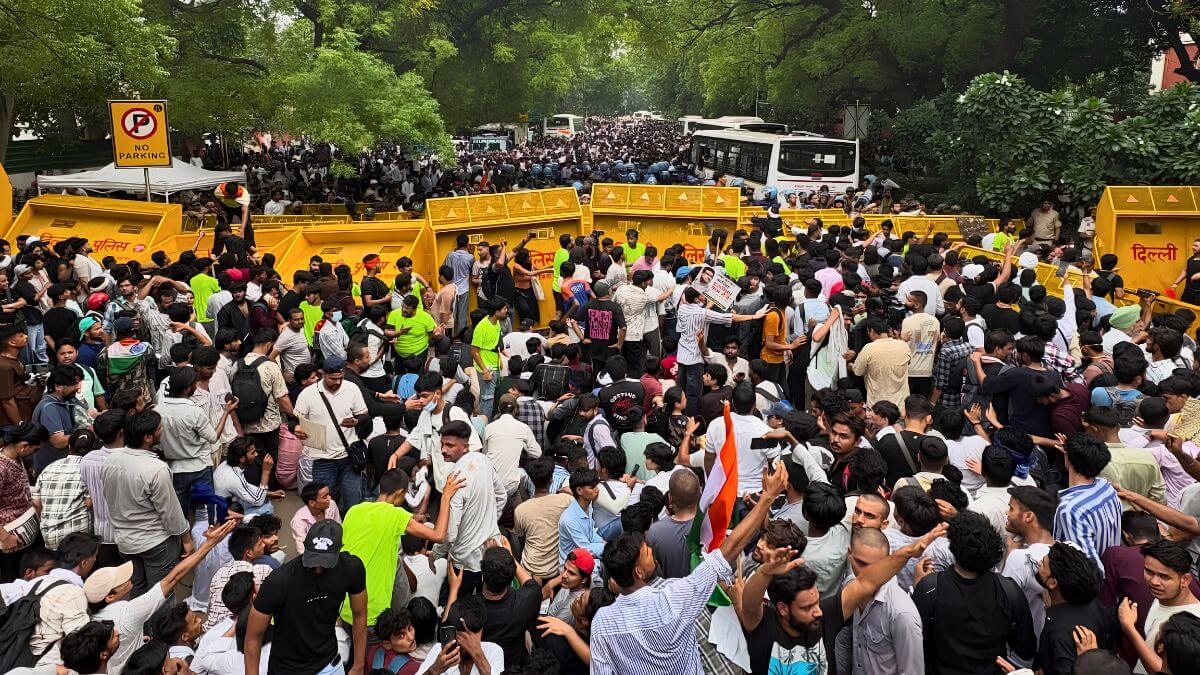
The Supreme Court on Tuesday took the unusual step of quashing criminal cases lodged against young protesters who took part in nationwide demonstrations organised by the Cockroach Janta Party over irregularities in the NEET-UG 2026 medical entrance exam, acting on a request from the Centre.
A bench led by Chief Justice of India Surya Kant, along with Justices Joymalya Bagchi and V Mohana, used its special powers under Article 142 of the Constitution to allow applications moved by the Centre, Delhi Police and the state governments of Maharashtra, Assam, Bihar and West Bengal, effectively closing all FIRs tied to the protests held between July 20 and 25.
The bench went further, ruling that any other FIR linked to the same round of protests anywhere in the country, even those not formally brought before the court, would also stand closed. The Chief Justice noted that the future of the young people who had taken part in good faith had weighed heavily on the court’s decision to invoke its extraordinary powers in this case.
As an exception, the court agreed to a request from the Centre allowing Delhi Police to keep pursuing action against a group of 2,873 individuals who were present at the Jantar Mantar protest site but who have serious criminal antecedents, including cases involving murder, rape and abduction, according to submissions made by Solicitor General Tushar Mehta.
Mehta told the bench that the government intended to honour the commitments it had made to Cockroach Janta Party representatives on July 25, including compensating the families of students who took their own lives following the cancellation of the NEET-UG 2026 exam. He asked for a three-month window to work out how that compensation would be structured, a request the court accepted while also directing the Centre to draw up a broader pan-India policy for compensating protesters hurt during police action, to later be adopted by individual states.
The court was careful to note that its directions applied to the particular circumstances of this case and should not be read as setting a precedent for future matters.
Following the ruling, CJP co-convener Saurav Das, who was present in court, announced that the organisation was calling off a march it had planned in the capital for September 5, citing the assurances given by the government and the backing those assurances had now received from the judiciary.
The protests had erupted after allegations surfaced that the NEET-UG 2026 question paper had been leaked, prompting students and young people across the country to demand accountability and reforms to how competitive exams are conducted. The Supreme Court had earlier set up a high-powered enquiry committee, headed by Justice R Subhash Reddy, to look into related complaints of excessive police action during the demonstrations.
